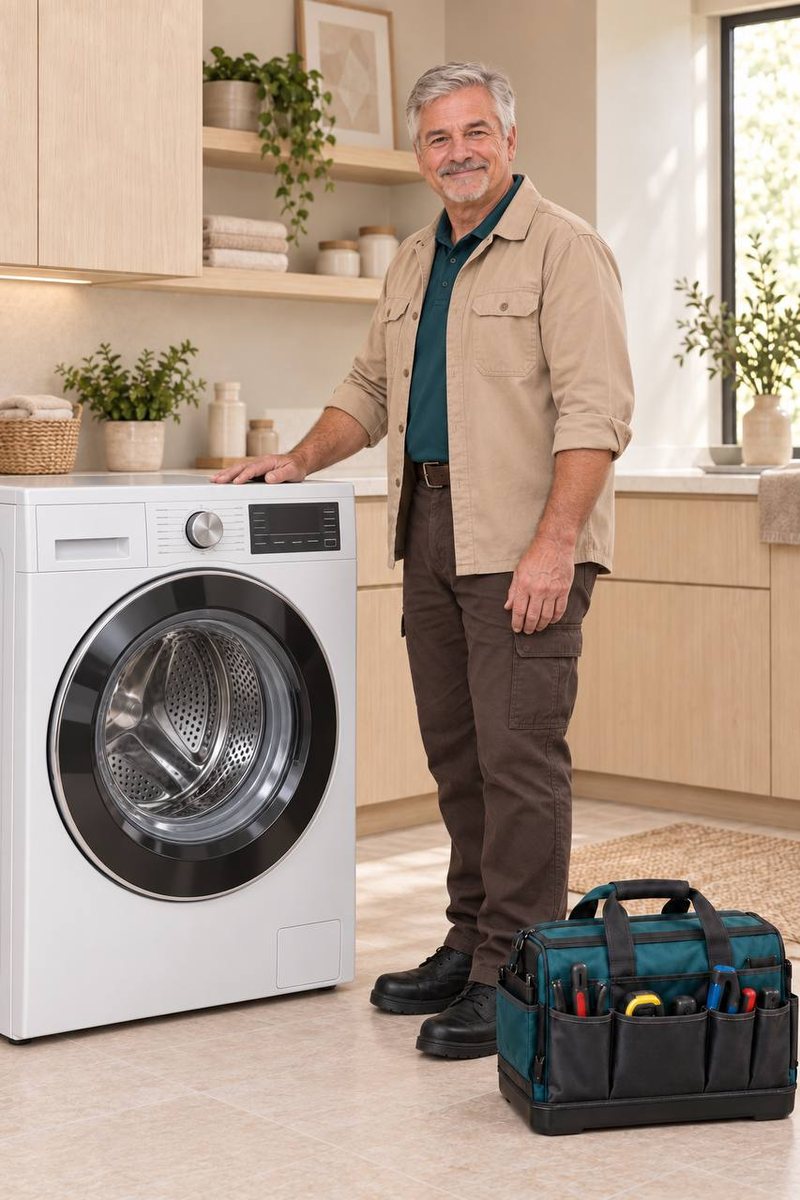
The door of a front-load washer seals against a rubber bellows, the boot, which flexes with the drum and channels splash back into the tub through small drain holes at the bottom. Anything that breaks that seal while the drum is spraying leaks down the front. A bra wire or a coin cuts the lip. A fold of the boot gets caught under the door frame when a big load is stuffed in. Grit and detergent sludge plug the drain holes so water pools in the fold and spills. The hinge wears and the door drops a few millimeters, so the glass no longer presses evenly. And too much detergent builds foam that climbs the drum and finds any gap.
The west metro leans hard on front-loaders, and where they sit matters. Stacked pairs in the townhomes around Eden Prairie Center and the new construction in Shakopee live in second-floor closets, where a door leak soaks a subfloor and shows up as a ceiling stain in the garage below. The hard well water most suburbs run on is the other factor. Minerals and detergent combine into a gray crust inside the boot fold and in its drain holes, and that crust both blocks drainage and stiffens the rubber so it no longer seals against the glass. A St. Louis Park bungalow with a basement washer forgives a leak; a Hennepin Village townhome does not.
Symptom by symptom
What you notice
What is really happening
Safe to check yourself?
What we do
Water runs down the glass during the wash
The boot lip is torn or nicked, or a fold is trapped under the door
Yes. Run a finger around the boot lip and look for a cut
Replace the boot and reseat the door alignment
Puddle only on heavy loads or bedding
The drum flexes far enough to open a gap at a worn spot in the boot
Yes. Wash a smaller load and see if it stays dry
Replace the boot, check the shocks that let the drum travel too far
Foam at the door and a leak that follows
Too much detergent or a non-HE product; suds climb the drum
Yes. Cut the detergent dose in half and run a hot empty cycle
Clear the suds, check the pressure sensor hose, reset the detergent habit
Water pools in the boot fold and spills when the door opens
The drain holes in the boot are plugged with sludge and hard-water crust
Yes. Wipe out the fold and pick the holes clear with a toothpick
Clean or replace the boot, descale the fold, and check the tub-to-boot clamp
Door sits low or scrapes the frame
The hinge has worn or its screws have loosened; the glass no longer meets the boot squarely
Yes. Lift the door gently by the handle and feel for play
Tighten or replace the hinge and re-square the door to the boot
Leak from the top of the door, not the bottom
The dispenser drawer is overflowing or clogged and running down the front
Yes. Pull the drawer and clean the softener siphon cup
Clean the dispenser housing, clear the hose, and confirm the fill valve closes
What you can safely do yourself
Wipe the boot fold dry after the last load and leave the door ajar to air out.
Check the boot lip for cuts, tears or a trapped sock before every wash for a week.
Halve your detergent dose; hard-water homes still make plenty of suds with less.
Pull the dispenser drawer and rinse the softener cup clear of gel.
Put a towel under the door and run a small load to find where the water starts.
Stop washing large comforters until the leak is found; the drum flex opens gaps.
When it is time to call
If you have found a cut in the boot, or the door sits low enough to scrape, the job is a call, not an experiment; the boot is clamped to the tub and the cabinet behind the front panel, and it is not a safe reach from the front. Call if the leak is on a second floor, since every wash adds water to the subfloor, and call if the leak comes with a banging drum, which points at shocks letting the tub hit the boot. We carry boots for the common LG, Samsung and Whirlpool front-loaders and fit them in one visit, then run a cycle to confirm it.
For a leaking front-loader the $99 diagnostic becomes part of the written repair price once you approve it; say no and $99 is the whole bill. The written warranty rides on the invoice. Request service →
Questions
Why is my front-load washer leaking from the door?
The door seals against a rubber boot, and the boot has either been cut, folded under the door, plugged at its drain holes, or is no longer being pressed evenly because the hinge has sagged. Excess suds can also push water past a healthy seal. The first three are visible with a flashlight around the lip; the hinge you feel by lifting the door; the suds you see.
Can I replace the door boot myself?
It is not a job we suggest for a homeowner. The boot is held by a spring clamp at the front and a band clamp at the tub, and reaching the tub clamp means removing the top, the front panel and often the door lock and dispenser. Getting the boot seated without a twist takes practice, and a twisted boot leaks worse than the old one.
Does hard water in Eden Prairie make the boot fail sooner?
It does. Well water in Eden Prairie and the neighboring suburbs runs hard, and the minerals combine with detergent to form a crust in the boot fold and its drain holes. The crust holds moisture, grows mold, stiffens the rubber and abrades the glass edge, so a boot that might last twelve years elsewhere shows wear at seven or eight. Wiping the fold dry and using less detergent slows it down.
Is it a leak or just condensation on the door glass?
Condensation is a fog on the glass with no water on the floor, and it is normal on a hot wash in a cold laundry room. A leak leaves a track down the front of the machine and a wet patch on the floor or the mat under the door. If you are not sure, tape a paper towel under the door lip and run a warm load.
What will the door leak repair cost?
You get the price after the diagnosis and before the work. The $99 diagnostic pays for finding whether it is the boot, the hinge, the dispenser or a habit, and that $99 is folded into the written number you approve. If it turns out to be detergent and the boot is sound, $99 is all you pay, plus advice on the dose and the wipe-down.
 Refrigerator & Freezer Repair$99 finds the fault · price on paper
 Washer Repair$99 finds the fault · price on paper
 Dryer Repair$99 finds the fault · price on paper
 Dishwasher Repair$99 finds the fault · price on paper
 Oven, Range & Cooktop Repair$99 finds the fault · price on paper