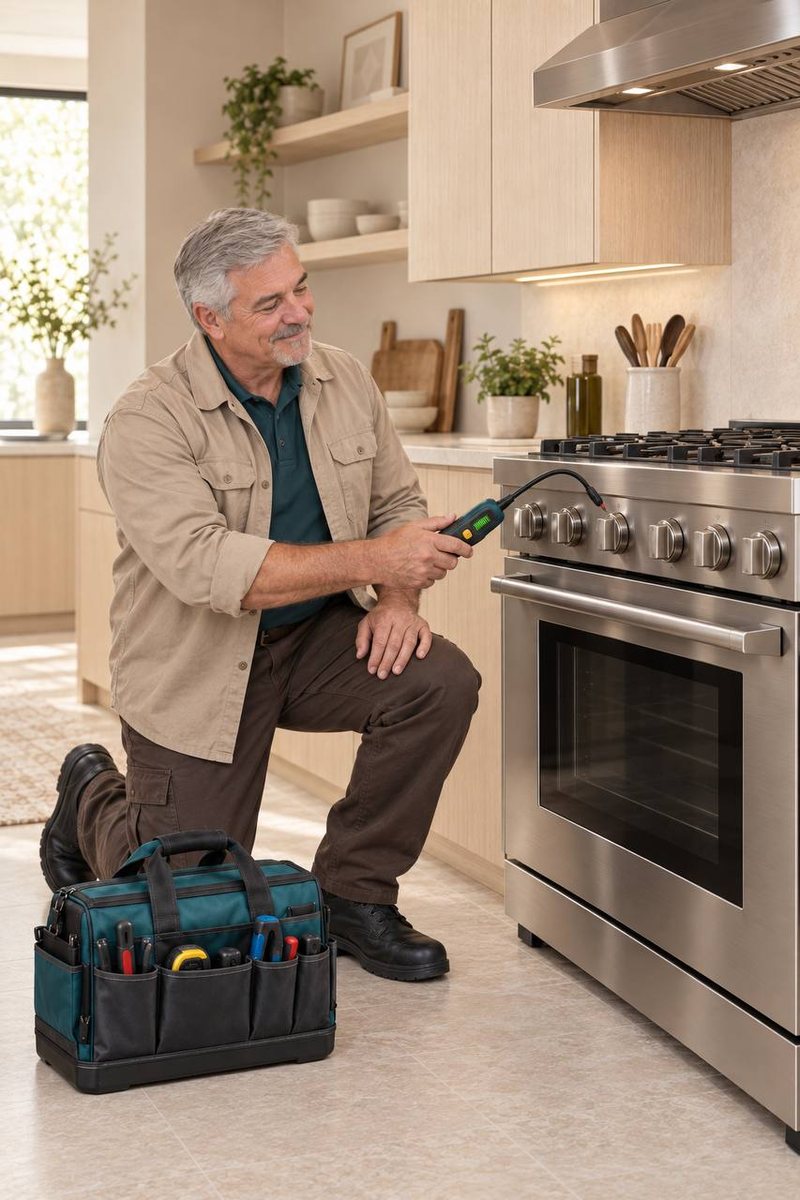
A GE range flashing F2, a GE dishwasher that quits with C1 or a puddle, a top-load washer that will not finish a spin.
Mon–Fri 8am–6pm · Sat 9am–3pm · Eden Prairie-based, no mileage charge inside 30 minutes

GE is the range brand of this side of the Twin Cities. Look under the cooktop in a 1950s rambler near Southdale, a 1970s colonial off Hwy 7 in Minnetonka, or a 2010s build on the Chaska bluffs, and the badge is often GE, Profile or Café. The dishwasher usually matches, because remodelers along 50th & France sell GE as a suite, and the rental buildings near Eden Prairie Center and the Mall of America buy GE top-load washers and dryers a hundred at a time. The failures are familiar: ranges throw F2, F3 or F7 and stop baking, dishwashers show C1 and hold water, top-loaders fill but never spin, and bottom-freezer refrigerators build ice under the drawer.
Then the west metro adds its own wear. Almost every suburb from Plymouth down to Burnsville runs on municipal wells, and the water leaves the tap hard enough to scale a GE dishwasher heater white within a year if the softener runs out of salt. Iron rides along in some neighborhoods and paints the tub orange. Inside a GE washer the same water narrows the inlet valve, and inside a GE refrigerator it chokes the ice maker fill line until the tray fills halfway. Winter does the rest: a GE dryer venting through a frosted wall cap near Staring Lake runs cool, and a garage refrigerator in Bearpath stops when the slab drops toward freezing.
| Machine | Common symptom | What it usually is | What we do |
|---|---|---|---|
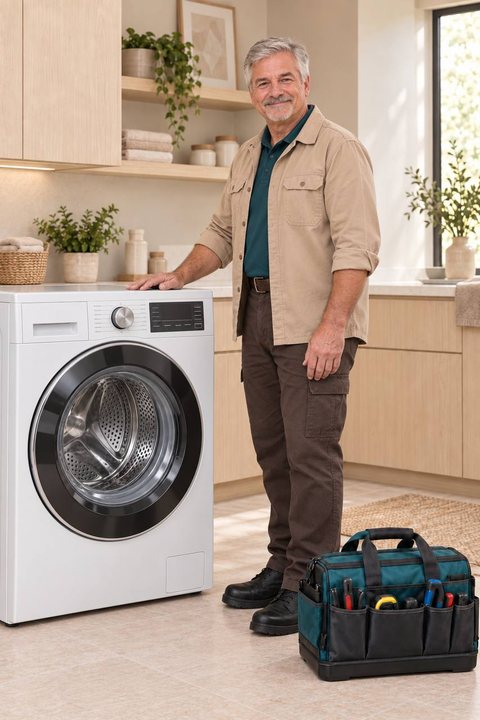
| Washer | Top-loader fills and agitates, then stops before spin with a locked lid | Lid lock or lid switch reading open, or a drive motor and inverter losing the position signal | Test the lock and switch, read the motor windings and the inverter output, replace the failed part and prove a full spin |
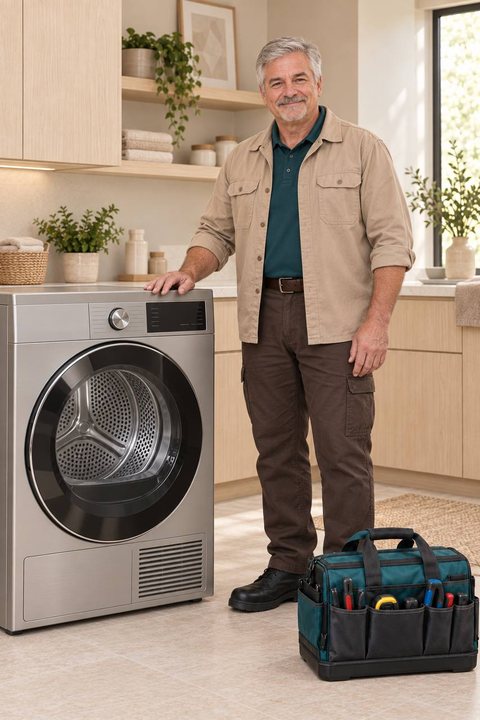
| Dryer | Long dry times, thermal fuse open, or drum stops turning | Restricted exhaust cooking the fuse, a worn belt, or a drum bearing that has flattened | Check the vent for airflow, ohm the fuse and thermostats, replace the belt or bearing, run a load to confirm |
| Refrigerator | Sheet of ice under the bottom freezer drawer, water on the kitchen floor | Defrost drain frozen shut, often with a failed drain heater or a clogged drain tube | Thaw and clear the drain, replace the heater or tube, check the defrost cycle so the ice does not rebuild |
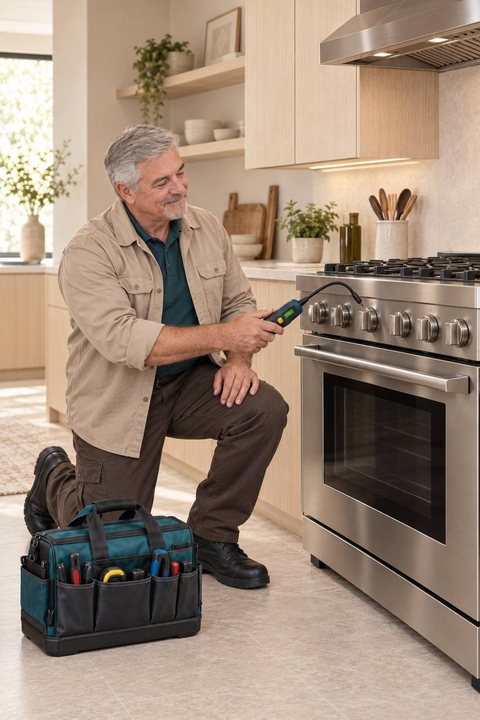
| Range / oven | F2, F3 or F7 on the display, oven shuts itself off | Oven sensor out of range, a relay that ran the oven too hot, or a shorted key in the touch pad | Read the sensor, test the relay board and keypad, replace the failed piece, verify the oven cycles at set temperature |
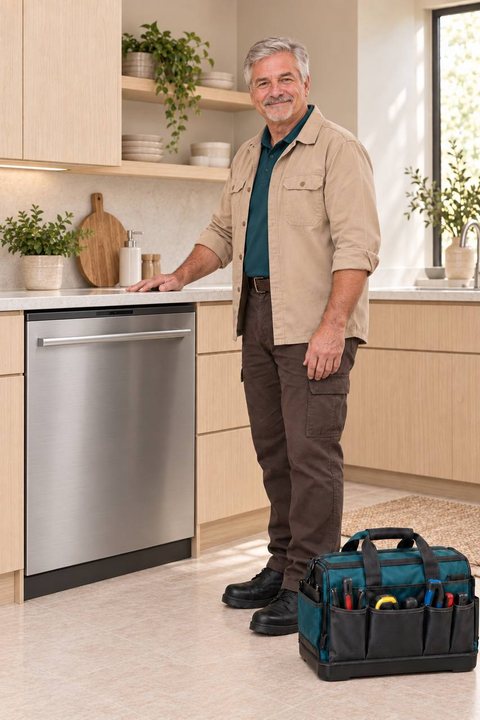
| Dishwasher | C1 code, water in the sump after the cycle, film on glassware | Drain pump slowed by scale or debris, check valve stuck, or a heater coated by hard water | Clear the sump and check valve, test the drain motor, descale and test the heater, run a wash and drain to confirm |
| Ice maker | Ice slows to a few cubes, then stops; fill tube frozen | Fill valve narrowed by scale, or a frozen fill tube in a cold garage or against an outside wall | Measure fill volume, replace the valve, thaw and reroute or insulate the tube, test the ice maker through a full harvest |
| Code | What it means | What we do |
|---|---|---|
| F2 | Oven over-temperature — the control saw the cavity run hotter than it should | Test the oven sensor and the bake relay, check the door lock on self-clean, replace the failed part |
| F3 / F4 | Oven temperature sensor reads shorted (F3) or open (F4) to the control | Ohm the sensor at room temperature, inspect the harness plug, replace the sensor, confirm bake accuracy |
| F7 | Stuck or shorted key on the range keypad, often after a spill | Disconnect the touch pad, test each key line, dry or replace the panel, verify the control responds |
| F9 | Door lock fault — the latch never reached the locked or unlocked position | Check the latch motor and switches, clear debris from the latch path, replace the assembly if it fails |
| C1 / C2 | Dishwasher drain took too long — the sump did not empty in time | Clear the sump, filter and check valve, test the drain pump, replace it when it runs weak |
| PF | Power failure — the control lost line voltage and stopped the cycle | Check the outlet and cord, test both legs of a 240-volt line, look for a loose neutral |
On a GE call the code is our starting point, not our conclusion. F3 says the oven sensor is reading shorted, and nine times out of ten the sensor is the part, but the tenth time it is a chafed harness behind the oven wall, so we ohm the sensor at its plug and at the board before naming anything. A dishwasher C1 gets the same discipline: we time the drain and pull the check valve before deciding the pump is done. The truck carries GE oven sensors, bake and broil elements, igniters, dishwasher drain pumps and check valves, washer lid locks, dryer fuses and belts, and the common refrigerator drain heaters. An ordered part means one return visit without a second trip fee.
GE machines span decades, so we ask the age before we quote. A GE range or dishwasher bought within the maker’s coverage window should be repaired under it, and we say so rather than charge you for work someone else owes. If you carry a store plan, show us the terms and we will tell you whether this failure falls under it. When the repair is ours, the price arrives in writing after the diagnostic and never before. The $99 you pay to have the fault found is folded into that number, so approving the repair does not stack a second charge on top. Decline and the $99 stands alone. Every completed GE repair is backed by a written warranty on the invoice.
Yes. Freestanding and slide-in GE ranges, gas and electric, and the GE, Profile and Café wall ovens built into remodeled kitchens in Eden Prairie are all regular work. Oven sensors, bake and broil elements, igniters, door latches and relay boards are the usual failures, and most are on the truck. We test with a meter, write one price, and finish most GE range calls in a single visit.
C1 tells you the dishwasher took too long to pump out, so the control stopped the cycle. On hard well water the drain pump and check valve gather scale and food grit, and the pump slows until the code appears. Check the filter and the air gap if your sink has one. If the code returns, we clear the sump, test the pump under load and replace it if it has lost its strength.
F2 means the control believes the oven ran hotter than it was set, and it shuts the heat off to be safe. Sometimes the sensor is drifting; sometimes a relay is welded on and the oven really is overheating. Do not keep running it. We test the sensor and the relay board, replace the faulty part, and confirm the oven holds temperature through a full bake before we leave.
Yes, measurably. Minneapolis softens its river water at the plant, while Eden Prairie, Minnetonka, Bloomington and the other suburbs pump hard well water into every GE dishwasher, washer and ice maker. A working softener closes most of that gap. When we find a scaled heater or a choked fill valve, we tell you what the water at the machine looks like so you can check the softener before the next part goes.
The diagnosis itself takes well under an hour, because we test rather than guess. If the part is on the truck, most GE range, dishwasher and washer repairs are finished within another hour, including a test cycle and cleanup. A part we have to order means a second visit, scheduled when it arrives, with no second trip fee. You know the total before either visit turns into a repair.
Call (763) 342-9995 or send the form. You get a callback with a real arrival window, and a text when the truck is on its way.
The technician tests the machine, names the failed part in plain words, and writes one flat price. The $99 is already inside it.
We stock the parts that actually fail in west-metro homes, so most jobs close the same visit; an ordered part comes back with no second trip fee.
Full test cycle before we pack up, a clean work area after, and a written warranty on the invoice.
One call starts it: $99 finds the fault, one written number, repair from the truck, written warranty.