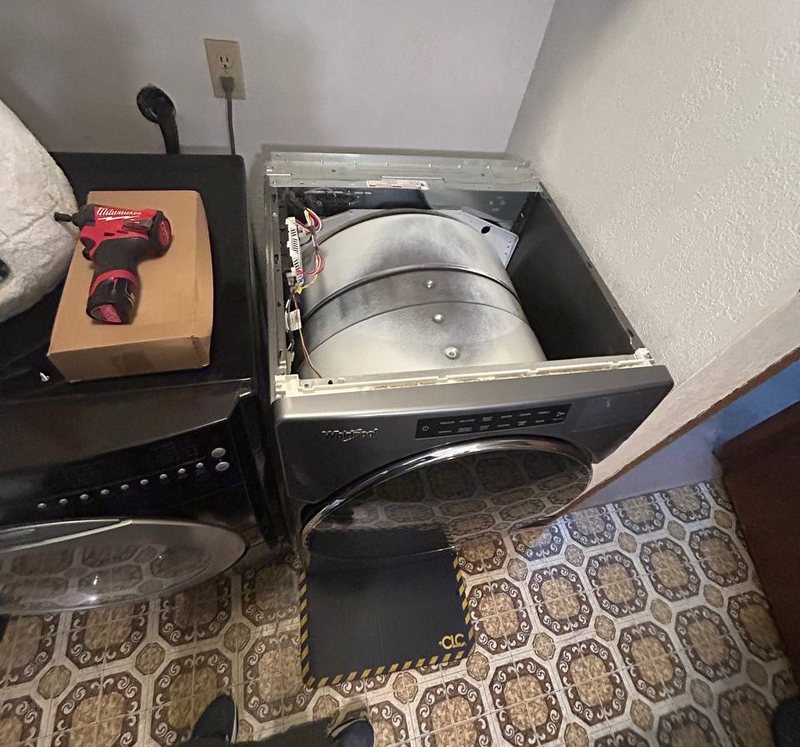
A dryer dries by moving warm air through wet clothes and out of the house. Winter attacks that in three places. At the far end, the vent hood flap freezes in a wet snow and sticks, while warm, moist exhaust hitting a cold duct in a garage or attic condenses and glues lint into a frost cake. In the middle, a heating element with one broken coil or a gas burner with a weak valve coil still produces heat, only less, and the difference is hidden until the room is cold. At the intake, a dryer in a chilly basement or a mudroom off the garage is heating air that starts twenty degrees colder than in September.
Where the dryer sits in a west-metro house decides which of those three bites hardest. The two-story homes of Chanhassen and the Eden Prairie subdivisions off Anderson Lakes Pkwy put the laundry upstairs, with a long vent run through a cold attic to a roof cap that ices over and never gets looked at. In Bloomington and Richfield ramblers the dryer is in the basement next to a rim joist that leaks January air, so the intake is cold and the hood on the back wall drifts under. Townhomes near Eden Prairie Center vent through the garage, where the duct sweats and freezes. The fix is different in each house, which is why we measure instead of guessing.
Symptom by symptom
What you notice
What is really happening
Safe to check yourself?
What we do
Towels need a second cycle only in cold months
The exhaust is partly blocked by an iced flap or frost-bound lint
Yes. Look at the outside hood while the dryer runs
Clear the duct end to end and fit a hood that sheds ice
Dryer feels warm but never hot
One coil of the element or one gas valve coil has failed
No. The element and burner are behind panels on live power or gas
Meter the element or the valve coils and replace the failed part
Loud rattle or a sweet burning smell with the slow drying
Lint has reached the blower or the heater box
No. Stop the dryer and leave it off
Open the dryer, clear the blower housing, replace the thermal fuse if it opened
Electric dryer runs but the air is cold
One leg of the 240-volt supply is out, or the element is open
Yes. Check the two breakers for the dryer are both on
Test the outlet and cord, then the element, high-limit and fuse
Clothes come out damp and the dryer stops early
The moisture sensor bars are coated with softener film
Yes. Wipe the two metal strips inside the drum with rubbing alcohol
Clean or replace the sensor and check the control board reads it
Slow drying started after a new dryer or a move
The transition hose behind the machine is crushed or too long
Yes. Pull the dryer forward and look
Replace with rigid duct and shorten the run
What you can safely do yourself
Brush snow away from a wall vent and confirm the flap swings when the dryer runs.
Clean the lint screen every load and wash it monthly to strip dryer sheet residue.
Wipe the moisture sensor bars inside the drum with a cloth and rubbing alcohol.
Dry towels on a timed cycle once and note how long they take as a baseline.
Make sure both breakers for an electric dryer are switched fully on.
Keep the laundry room door open so the dryer can draw room air without restriction.
When it is time to call
When the vent is clear and the hood swings open but towels still take two runs, the dryer is not making enough heat, and that is a meter job: the element, the gas valve coils, the cycling thermostat and the 240-volt supply get tested in a few minutes. Call if there is a burning smell, if the top of the dryer is hot to the touch, or if the run ends in a roof or an attic you cannot reach. Frost-packed lint sitting against a heater is the one dryer problem that should not wait for a week. We clean the vent and test the machine on the same visit.
Slow winter drying gets the same deal as every Loon visit: a $99 diagnostic that folds into one written price, the repair from the truck, and a written warranty when we leave. Request service →
Questions
Why does my dryer take longer in winter than in summer?
Three reasons stack up. The exhaust hood outside can ice or drift shut, moist exhaust condenses in a cold duct and cements the lint, and the dryer is pulling in colder room air that takes longer to heat. A machine that was marginal in warm weather, with a weak element or a half-blocked vent, crosses the line into two cycles when all three arrive at once.
Is a two-cycle dryer dangerous or just annoying?
It can be both. The extra time is the annoyance. The danger is that a restricted vent makes the heater cycle on its high-limit thermostat and packs lint closer to the heat source. Dryer fires in this country trace mostly to lint and blocked exhaust. If you smell anything hot or scorched, stop using the dryer and have the vent and heater checked.
My vent goes through the roof in Chanhassen. Can you clean that?
Yes. Roof-vented runs are common in two-story homes across Chanhassen, Eden Prairie and Plymouth, and they need cleaning from both ends with proper equipment, not a leaf blower. We clear the duct, check the roof cap for ice damage and a working flap, and then confirm airflow with a meter at the dryer so you know the restriction is gone rather than moved.
Could it be the heating element even though the dryer gets warm?
Yes, and it is one of the most common winter finds. An electric element is a long coil, and when one section breaks the rest still glows, giving perhaps two-thirds of the heat. Gas dryers do the same when one of the two valve coils weakens and the burner drops out early. Both show up on a meter in minutes and both are truck-stock repairs.
Do you charge extra for the vent cleaning on a dryer repair?
The vent check is part of every dryer diagnosis, because a repair on a dryer that cannot breathe does not last. If the duct needs a full cleaning, that is written into the single number you approve along with any parts, with the $99 diagnostic already inside it. Nothing is added afterward, and the invoice carries a written warranty on the work.
 Refrigerator & Freezer Repair$99 finds the fault · price on paper
 Washer Repair$99 finds the fault · price on paper
 Dryer Repair$99 finds the fault · price on paper
 Dishwasher Repair$99 finds the fault · price on paper
 Oven, Range & Cooktop Repair$99 finds the fault · price on paper