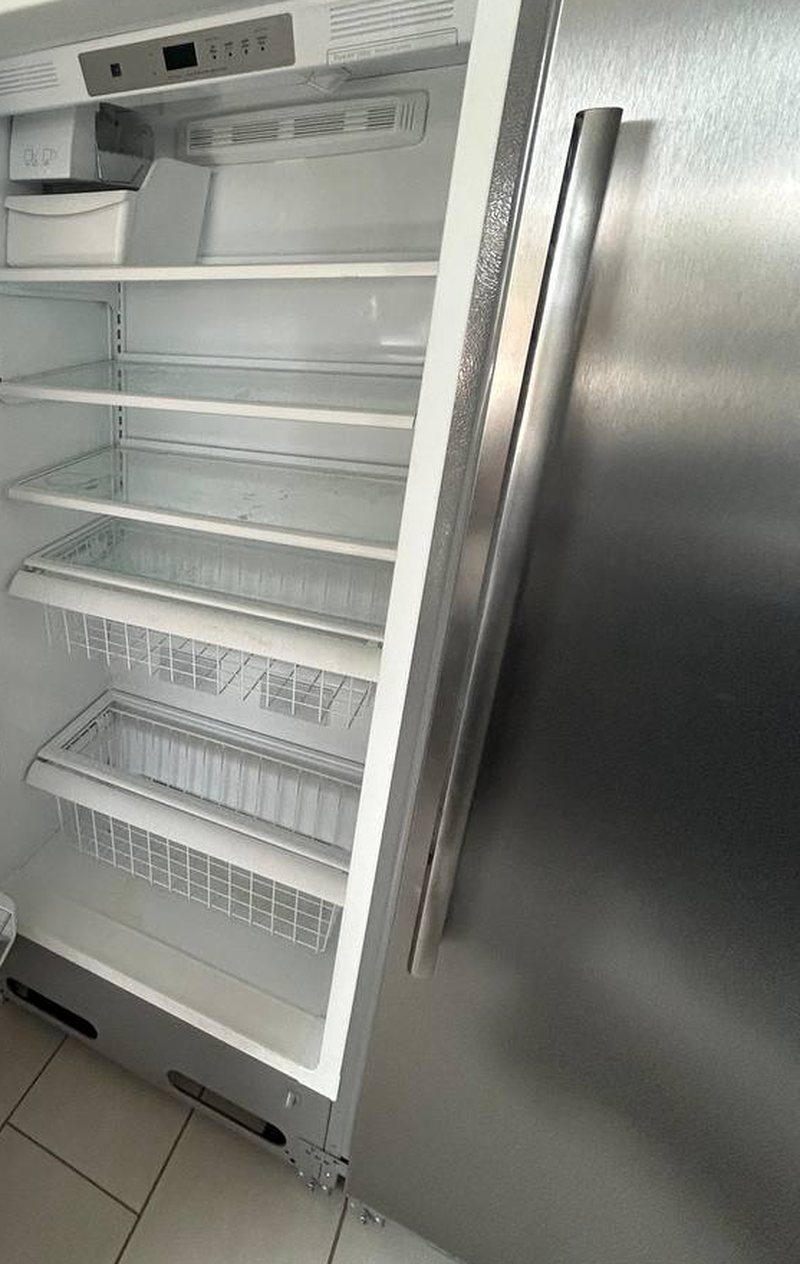
Ice maker slow or stopped: hard water in the west metro
An ice maker is a simple sequence. A solenoid valve at the back of the refrigerator opens for a few seconds and sends water up a tube into a mold; the mold freezes; a heater loosens the cubes; an arm sweeps them into the bin; the cycle repeats. Scale interferes at the first step. Minerals precipitate inside the valve as water sits between fills, narrowing the passage until the timed fill delivers less water than the mold expects. Undersized fills freeze faster and hollow. Even less water and the fill barely reaches the tube, where it freezes on the way in and seals the tube shut. From there the ice maker cycles empty until the control gives up.
Minneapolis homes on river water softened at the plant see far less of this than the suburbs do. Eden Prairie, Chanhassen, Shakopee and Plymouth pump well water at 15 to 25 grains of hardness with iron along for the ride, and unless a softener stands between the well and the refrigerator, the fill valve is coated within a couple of years. When a softener runs dry, the ice maker is the first appliance to complain, ahead of the dishwasher. Iron adds orange flecks to the cubes and a metallic taste. Winter brings a second failure: fill lines routed through a garage wall or an unheated mudroom freeze solid the week the temperature drops below zero.
Symptom by symptom
What you notice
What is really happening
Safe to check yourself?
What we do
Cubes are small, hollow or crescent-thin
The fill valve is scaled and delivering too little water per cycle
Yes. Check the softener salt and the water filter date
Replace the inlet valve, flush the line, verify the fill volume
No ice, and a lump of ice at the top of the fill tube
A short fill froze in the tube and blocked it
Yes. Look at the tube where it enters the mold
Thaw the tube, replace the valve that caused the short fill, check the tube heater if fitted
Cloudy cubes with white grit in the glass
Hard water freezing from the outside in traps minerals in the center
Yes. Taste the tap water and check the softener
Restore softened water and change the filter; the cubes clear in a few cycles
Orange or brown cubes
Iron in the well water, often after a softener bypass was left open
Yes. Check the softener bypass valve position
Flush the valve and line, replace the filter, and advise on iron treatment
Ice maker runs but the bin stays half empty
Freezer is running warm, or the mold thermostat is slow to trigger
Yes. Read the freezer temperature; it should be near zero
Test the mold thermostat and the freezer’s cooling, replace what reads out of range
Stopped in January in a garage or mudroom fridge
The supply line through a cold wall has frozen and may have split
Yes. Shut the water valve to the fridge and look for a wet spot
Thaw the line, replace split tubing, reroute or insulate it away from the cold
What you can safely do yourself
Check the softener brine tank and confirm the bypass valve is set to service.
Replace the refrigerator water filter on schedule; a plugged filter starves the fill.
Look at the fill tube where it meets the mold for an ice plug.
Read the freezer temperature with a thermometer; ice makers stall above about ten degrees.
Empty the bin and let the maker rebuild after a softener has been refilled.
Turn off the supply valve to a garage fridge before a subzero stretch.
When it is time to call
If the softener is working, the filter is fresh and the freezer is cold, an ice maker that still makes small or no ice has a scaled valve, a stuck mold thermostat or a failed module, and each of those is a part, not a habit. Call then. Call sooner if you find water under the refrigerator or a wet wall behind it, because a fill tube or supply line that froze may have split. We carry inlet valves and ice maker assemblies for Whirlpool, GE, Samsung, LG, Frigidaire and KitchenAid, so most of these jobs finish on the first visit with the fill volume measured before we go.
Ice maker repairs run on the same rule as everything else we touch: $99 to diagnose, folded into the written price if you approve the repair, with a written warranty on the invoice. Request service →
Questions
Why are the ice cubes from my refrigerator small and hollow?
The mold is getting less water than it should. Each fill is timed rather than measured, so a valve narrowed by scale delivers a short pour, and a short pour freezes into a thin shell around an air pocket. In west-metro homes on well water this is the single most common ice maker fault, and it almost always traces back to a softener that ran low or a filter left in too long.
Will a new water filter fix a slow ice maker?
Sometimes, if the filter was the restriction. A filter past its date drops the flow to the ice maker before it affects the door dispenser, so slow ice is often the first sign. If a fresh filter does not bring the fill volume back within a day or two, the scale is inside the valve, and the valve needs replacing rather than cleaning.
Is the ice maker part of the refrigerator repair, or a separate call?
It is one visit and one diagnosis. The ice maker is a module inside your refrigerator, fed by the same water line and cooled by the same freezer, so we look at the fill valve, the line, the freezer temperature and the module together. If the freezer itself is running warm, that gets fixed first, since no ice maker works in a freezer above ten degrees.
Why does the fill tube keep freezing in my Chanhassen kitchen?
A fill tube freezes when water arrives too slowly to clear it before the freezer air catches up, and hard Chanhassen well water scaling the valve is the usual reason for the slow pour. Some refrigerators have a small heater on the tube that can fail too. Thawing the tube with a hair dryer helps once; replacing the valve stops it coming back.
What does the ice maker visit cost?
The $99 diagnostic covers testing the valve, the line, the module and the freezer. If a part is needed, the $99 is already in the written price you approve, and most valves and modules are on the truck. If the answer turns out to be a softener out of salt, we say so and you owe the $99 alone, along with a clear note on what to fix on the softener side.
 Refrigerator & Freezer Repair$99 finds the fault · price on paper
 Washer Repair$99 finds the fault · price on paper
 Dryer Repair$99 finds the fault · price on paper
 Dishwasher Repair$99 finds the fault · price on paper
 Oven, Range & Cooktop Repair$99 finds the fault · price on paper