Your Whirlpool or KitchenAid oven beeps, shows an F followed by a number, and refuses to bake.
Mon–Fri 8am–6pm · Sat 9am–3pm · Eden Prairie-based, no mileage charge inside 30 minutes

Whirlpool and KitchenAid share the same control platform, so their codes mean the same thing. Older ranges show a two-character code; newer ones add a second pair, such as F3 E0, that narrows the fault. F1 is the control board itself, a memory or relay failure. F2 on the older boards means the oven ran hotter than commanded, while F2 E0 or E1 on newer ones flags a stuck or disconnected keypad. F3 and F4 are the oven temperature sensor, open or shorted. F5 covers the door switches and the self-clean lock, and F9 reports a latch that will not lock or unlock. Every one of them stops the bake until the fault clears or the part is replaced.
The west metro has a great many of these ovens. KitchenAid double wall ovens went into the built-in kitchens of Edina’s Indian Hills and Rolling Green and the Minnetonka lake homes in the 1990s and 2000s, and Whirlpool ranges came with nearly every builder package in Chanhassen and Shakopee. Two things here bring the codes on. Self-clean cycles run before Thanksgiving push a fifteen-year-old sensor and door latch past their limit, which is why F3 and F9 cluster in November. And winter static, furnace-dry air and the power blips that follow an ice storm are hard on control boards, so F1 tends to appear after the lights flicker.
| What you notice | What is really happening | Safe to check yourself? | What we do |
|---|---|---|---|
| F1 (or F1 E0 / F1 E1), oven dead or beeping | The electronic oven control has a memory or relay fault | Yes. Turn the breaker off for a minute and back on, once | Test the board’s outputs and supply, replace the control if it fails |
| F2 on an older range, oven ran very hot | A relay stuck closed or the sensor read low, and the oven overshot | Yes. Turn the oven off and let it cool; do not use it | Meter the sensor, test the bake and broil relays, replace the failed part |
| F2 E0 or F2 E1 on a newer model | The keypad has a shorted key or its ribbon connector has come loose | Yes. Wipe the panel dry; a wet or greasy key can short | Reseat or replace the keypad and membrane, then confirm every key |
| F3 or F4, oven will not preheat | The temperature sensor probe is open or shorted; the board has no reading | Yes. Look at the probe in the back wall for damage, without pulling it | Meter the sensor at room temperature, replace it, and check the harness |
| F5, door open or self-clean will not start | A door switch disagrees with the lock, or the lock motor did not travel | Yes. Open and close the door firmly and try again | Test the switches and the lock motor, replace the latch assembly if needed |
| F9, door locked after self-clean, or latch clicking | The latch motor or its position switch has failed | Yes. Let the oven cool fully, then cycle power once | Release the latch, replace the motor or switch, and run a lock test |
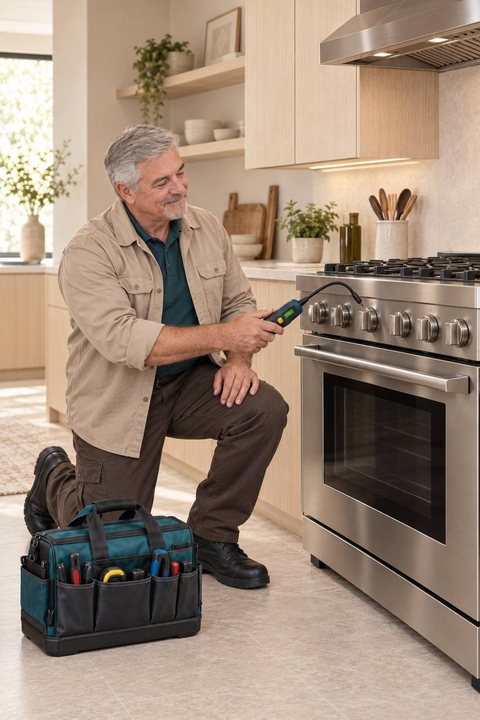
A code that clears with a power cycle and stays away can be watched. A code that returns the same day, or an oven that keeps heating after you press Cancel, is a call right now; F2 on an older board means the oven overshot, and a relay stuck closed can take the cavity past 600 degrees. F1, F3, F5 and F9 do not fix themselves; each names a failed part. We meter the sensor, the switches and the board outputs, and the sensors and latches for common Whirlpool and KitchenAid models ride on the truck. Control boards are often ordered, and the return visit carries no second trip fee.
F1 is the control board reporting a fault in itself: a memory checksum error on newer boards (F1 E0 or F1 E1) or a stuck relay on older ones. A power cycle at the breaker sometimes clears a one-time glitch after a storm. If F1 comes back, the electronic oven control is replaced; there is no smaller part to swap. The same code appears on KitchenAid, since the boards are shared.
No, because the oven has lost its temperature reading and will not run the bake or broil elements without one. F3 E0 means the sensor circuit is open, usually a failed probe or a chewed harness behind the oven. The probe is a quick truck-stock part on most KitchenAid wall ovens, and we test it at room temperature with a meter before replacing it.
Self-clean takes the oven to roughly 880 degrees for hours, which is hard on the door latch motor, the sensor and the wiring near the cavity. A latch that was sluggish fails to unlock and posts F9 or F5; a sensor near the end of its life drifts and posts F3. Many Edina and Minnetonka homes run self-clean once a year before the holidays, and that is when we get these calls.
Usually not. Let the oven cool completely, cycle power at the breaker, and the latch motor may finish its travel. If the door stays locked, do not force it; the latch hook can bend the door frame. The motor or its position switch has failed and needs replacing, and we can release the latch by hand from behind the control panel on the visit.
Yes. The $99 diagnosis comes first: we read the code, meter the sensor, switches, latch and board, and name the part. Then you get one written number with that $99 already inside it. If it is a control board that has to be ordered, the return trip has no extra fee, and the written warranty covers the work either way.
Call (763) 342-9995 or send the form. You get a callback with a real arrival window, and a text when the truck is on its way.
The technician tests the machine, names the failed part in plain words, and writes one flat price. The $99 is already inside it.
We stock the parts that actually fail in west-metro homes, so most jobs close the same visit; an ordered part comes back with no second trip fee.
Full test cycle before we pack up, a clean work area after, and a written warranty on the invoice.
One call starts it: $99 finds the fault, one written number, repair from the truck, written warranty.