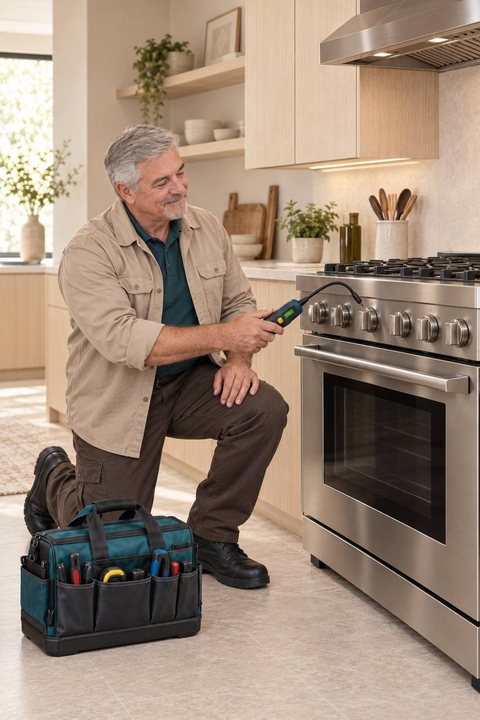
Also on the truck · Minneapolis
The rest of the lineup
Same $99 diagnostic, same written price, same written warranty on every machine we fix in Minneapolis.
A burner clicking without a flame in Lynnhurst, a Fulton oven stalled at 300 degrees an hour before guests arrive, an F-code on a Linden Hills wall oven.
Mon–Fri 8am–6pm · Sat 9am–3pm · Eden Prairie-based, no mileage charge inside 30 minutes
Same $99 diagnostic, same written price, same written warranty on every machine we fix in Minneapolis.
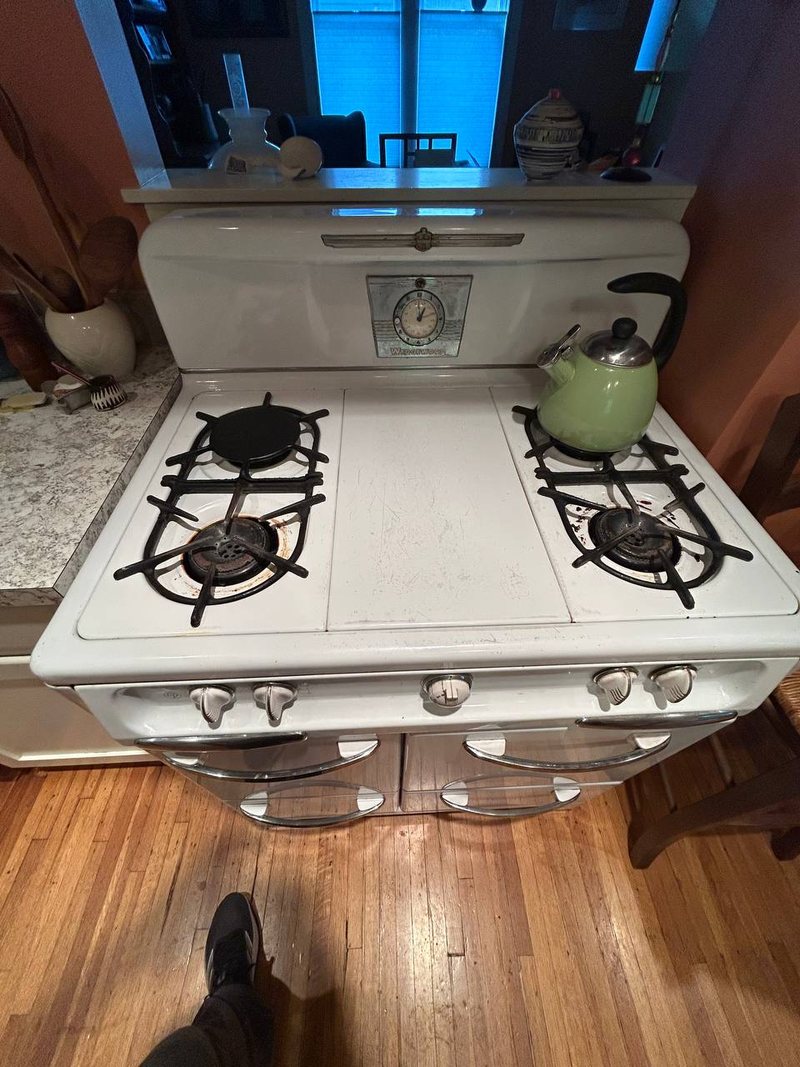
From Prairie Center Dr we take Hwy 212 to I-494, then Hwy 100 north and 50th Street east, and inside twenty blocks the kitchens change completely. Bloomington and Edina were built with 240-volt range circuits; the bungalows of Fulton, Kingfield and Tangletown were built with a gas pipe and a 60-amp panel. Even after two rounds of remodeling, most ranges on this side of Minneapolis are gas, and many of the electric ones run on a circuit added later beside the old fuse box. Wall ovens appear in the 1950s and 60s kitchen updates, and induction cooktops in the recent Lake Harriet remodels. Each generation fails in its own way, and the truck is stocked for all of them.
The oven call that defines this neighborhood comes in late November. A gas oven in a Kenny Tudor that has been heating a little slowly since summer takes most of an hour to reach 350, then loses temperature every time the door opens, and by the day before Thanksgiving it will not pass 300. That is an igniter drawing too few amps to open the safety valve fully, and it has been failing for months. Electric ovens on the same blocks fail with a bake element that splits and sparks, or a control board that throws an F-code after a Minnesota thunderstorm knocks the power off and on. Both are measured problems with measured fixes.
The igniter is glowing but weak. It must pull a certain amperage to open the gas valve, and an aging igniter falls short, so gas trickles instead of flows. We clamp a meter on the igniter circuit, confirm the draw, replace the igniter, and time the oven to temperature before we leave.
A wet or cracked spark igniter, a clogged burner cap after a boil-over, or a spark module that has lost one output. In old Minneapolis kitchens the cap is often just misaligned after cleaning. We dry, seat and test each burner, and swap the module only if the meter shows a dead channel.
Nearly always the bake element, which often shows a visible blister or break. Sometimes the relay on the board that feeds it. We read the element for continuity, check for voltage at the terminals with the oven calling for heat, and replace what the reading names.
A radiant element that has opened, or an infinite switch that has welded shut. A switch stuck on is a hazard, so we treat it as urgent. We test the element and the switch separately, and inspect the glass for the hairline crack that a stuck burner sometimes causes in Kingfield kitchens.
F1, F2, F3 and their brand-specific cousins point at the oven sensor, the door lock or the control board. The sensor should read about 1,080 ohms at room temperature; anything far off explains an oven that runs hot or cold. We test the sensor first because it is the common, inexpensive cause.
The thermal fuse behind the back panel opened during the high-heat cycle, or the door lock jammed. Common on older wall ovens in Linden Hills and Armatage. We replace the fuse, check the lock motor, and explain why we suggest skipping self-clean on a thirty-year-old oven.
An oven diagnosis is a temperature problem, so we start with a thermometer and a clock. How long to 350, how far it overshoots, how much it drops when the door opens: those numbers point toward the igniter, the sensor or the control before a panel comes off. Then the meter confirms. Igniter amperage tells us whether gas is reaching the burner; element continuity tells us whether electricity is reaching heat; sensor resistance tells us whether the control knows the truth. On gas ranges we finish with a leak check at every joint we disturbed. In a 1928 Tangletown kitchen where the range sits in a nook cut for a wood stove, we work in the space we have and leave it cleaner than we found it.
Whirlpool, GE, Frigidaire and Samsung ranges are the everyday machines of Kingfield and Lynnhurst; KitchenAid, Bosch and Thermador appear in the remodeled kitchens toward Lake Harriet, and Wolf and Viking in a handful of the bigger Tudors along Minnehaha Parkway. In the Uptown rental stock a dead oven is a habitability complaint, so we schedule with the tenant, text the written price to the property manager for approval, and email invoice and warranty when the oven has held temperature through a full cycle. One rule covers every oven and range repair in Minneapolis. The $99 diagnostic is folded into the repair you approve, and all pricing follows the diagnostic, in writing.
Almost certainly a weak igniter. It glows but does not draw enough current to open the gas safety valve fully, so the burner runs starved. Igniters weaken over months, which is why the oven seemed fine in June and hopeless by Thanksgiving. It is a stocked part on most Whirlpool, GE, Frigidaire and Kenmore ranges and a same-visit repair in Fulton or Kenny.
Yes. Wall ovens from the 1990s and 2000s are common in Minneapolis kitchens that were updated once and never again, and cooktops, gas, glass-top and induction, are common in the recent remodels. We test and repair each on its own, including the double wall ovens where one cavity works and the other does not.
We can repair the range, and we will tell you plainly if the supply is the real problem. A 240-volt circuit added in 1965 to a Tudor in Lynnhurst can deliver low voltage under load, and an electric oven on that circuit heats slowly through no fault of its own. If our readings point at the wiring rather than the appliance, you hear that before any part is sold.
Yes, and it should not be used until repaired. On a glass-top or coil range that is an infinite switch that has failed closed, and it will keep the element at full power regardless of the knob. Turn off the breaker for the range and call. Switches are a truck-stock part and the repair is usually finished in one visit.
Every price is written after the diagnosis, never before, because a cold oven can be an igniter or a control board and the two are not priced alike. The $99 diagnostic is folded into the repair price when you approve it; if you decide not to proceed, $99 is your full charge. No mileage fee applies to Minneapolis.
Call (763) 342-9995 or send the form. You get a callback with a real arrival window, and a text when the truck is on its way.
The technician tests the machine, names the failed part in plain words, and writes one flat price. The $99 is already inside it.
We stock the parts that actually fail in west-metro homes, so most jobs close the same visit; an ordered part comes back with no second trip fee.
Full test cycle before we pack up, a clean work area after, and a written warranty on the invoice.
One call starts it: $99 finds the fault, one written number, repair from the truck, written warranty.