Also on the truck · Bloomington
The rest of the lineup
Same $99 diagnostic, same written price, same written warranty on every machine we fix in Bloomington.
A Bloomington oven that will not climb past 275, a burner that clicks all evening, an F-code the night the in-laws arrive: we clamp the igniter, meter the element, read the sensor, and write one price.
Mon–Fri 8am–6pm · Sat 9am–3pm · Eden Prairie-based, no mileage charge inside 30 minutes
Same $99 diagnostic, same written price, same written warranty on every machine we fix in Bloomington.
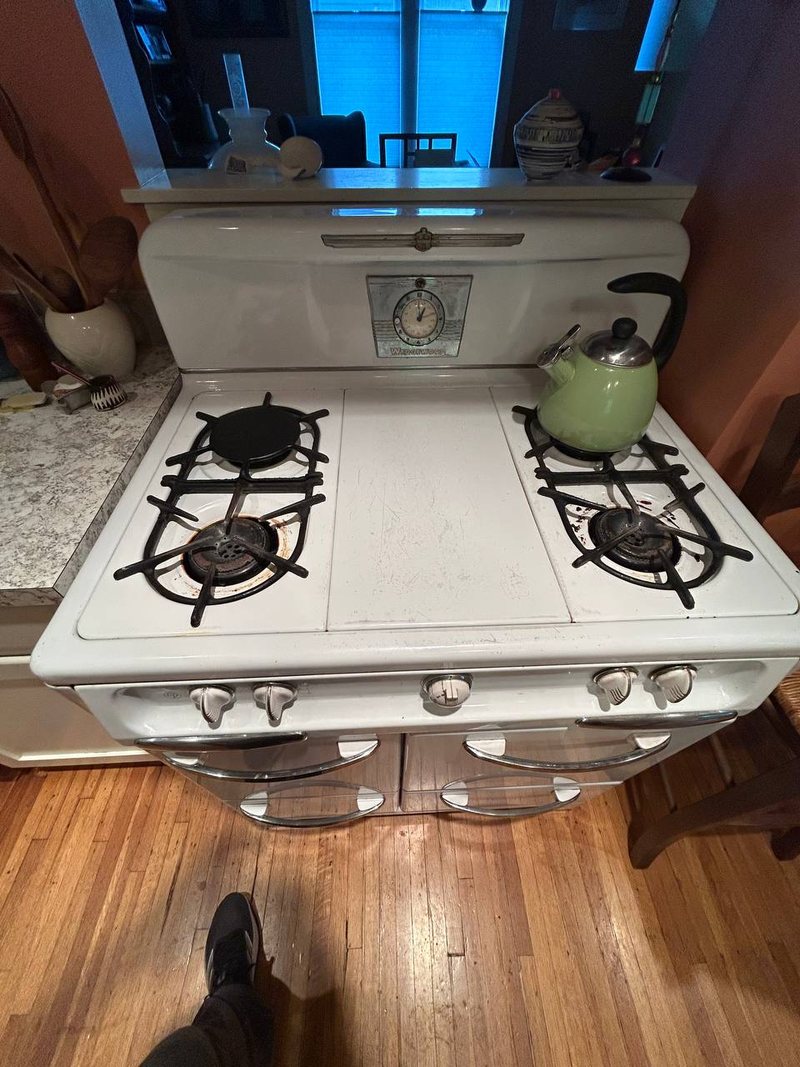
The 1950s ramblers east of France Ave were built with gas, and most still cook on it: a freestanding range against the wall in a galley kitchen, often a Whirlpool or GE replaced twice since the house went up. The split-levels west of France, around Hyland Lake, Normandale and Bush Lake, went electric with the 1970s, and a lot of them have moved to a glass-top or a slide-in induction range in a remodel. The apartment buildings along American Blvd and Old Shakopee Rd run coil-top electric ranges by the hundred, and a manager’s text about a dead oven in unit 214 is a normal Monday. We come in on I-494 with igniters, elements and switches for all three.
Picture a Sunday in Oxboro. The oven is set to 375, the display says it is there, and the roast is grey after an hour. A thermometer on the rack reads 280. On a gas oven that is a glow-bar igniter that still lights the burner but draws too little current to hold the safety valve open, so the burner drops out every few minutes. On an electric oven it is a bake element that has partly opened or a sensor drifting high. The second most common Bloomington call is a spark igniter that clicks without lighting because someone boiled over a pot of wild rice soup onto the burner ports. Both are usually fixed in the same visit.
Plugged burner ports after a spill, a cracked igniter electrode, or a spark module that has lost one output. We clear the ports, meter the igniter and the switch, test the module. If every burner clicks without a flame, we check the supply pressure and the regulator before anything else.
Gas: a weak igniter that cannot pull the current the safety valve needs. Electric: a broken bake element or an oven sensor reading high. We clamp the igniter during a heat call and read the sensor against a thermometer in the cavity, then replace the one that is out of range.
F1 through F3 on Whirlpool, KitchenAid, GE and Frigidaire ovens usually point to the sensor, the keypad or a relay; F9 and its cousins are the door lock. We look up the code for the model, meter the part it names, and verify before ordering a board, which is not always the culprit.
An open radiant element under the glass, or an infinite switch behind the knob with a welded or burnt contact. Stuck on high is the switch. We lift the top, meter both, and replace the failed one. Elements and switches for common Whirlpool, GE and Frigidaire tops are on the truck.
The lock motor did not retract when the oven cooled, the lock switch failed, or a high-limit thermostat tripped during the clean cycle. We release the door, test the lock assembly and the thermostat, and tell you whether this oven should be self-cleaned again.
A convection motor that has seized, a fan blade loose on its shaft, or a broil element that has opened so the top of the cavity runs cold. We meter the motor and both elements. Uneven baking in a wall oven often turns out to be a sensor sitting out of calibration rather than a fan.
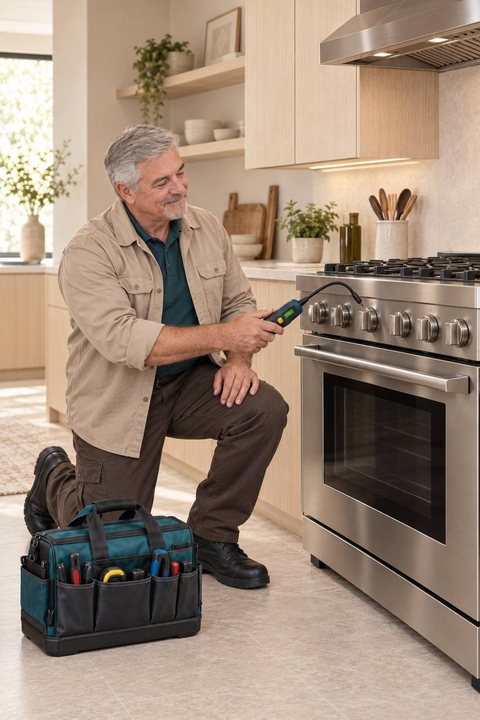
Every range gets the same sequence. Supply first: gas pressure and a leak check at the connector, or voltage at the terminal block. Then the bake and broil circuits are metered, the glow-bar igniter is clamped for amperage while the oven calls for heat, and the sensor’s resistance is read against a thermometer on the rack as the cavity climbs. Cooktop positions are tested at the switch and at the burner or element. When the failed part is confirmed we name it in plain words and write a single number. In a Bloomington apartment, that number goes to the owner by text; in a Hyland Lake kitchen, it is handed to you at the counter. Repair follows approval.
Whirlpool, GE, Frigidaire, Maytag, Samsung, LG, KitchenAid, Bosch and Electrolux ranges make up nearly all of the Bloomington calendar, with Amana and Kenmore in the older ramblers and the occasional Wolf or Thermador in the newer houses on the bluff above the Minnesota River. Property managers on American Blvd, Lyndale Ave and 98th St can run the whole visit by text with the tenant hosting. We work on the appliance side of the gas shutoff only; supply piping is a licensed gas fitter’s job. The cost is one written number after the diagnostic, with the $99 already inside it. Choose not to repair and $99 is the entire bill. Nothing is priced sight unseen.
The control believes the sensor, and the sensor is wrong, or on a gas oven the igniter has weakened so the burner drops out repeatedly. We read the sensor against a thermometer and clamp the igniter for current. Either part is a same-visit replacement on most ranges; sometimes only a calibration offset is needed.
Yes, by the dozen. Coil elements, receptacles, infinite switches and bake elements for the GE, Frigidaire, Whirlpool and Amana ranges common in buildings along American Blvd and Old Shakopee Rd are on the truck. The tenant hosts, the owner approves by text, and the paperwork goes out by email.
A slow-lighting burner is letting gas out before the flame catches, which is unpleasant and worth fixing, though not usually dangerous in a ventilated kitchen. Do not leave it unattended. We clean the ports, test the igniter and module, and leak-check the range connection before we leave.
Often. Pan detection faults, a failed inverter board on one side, and a stalled cooling fan are the usual causes. We test with a known magnetic pan, check the fan, and read the diagnostic mode. A board is ordered and fitted on a return visit with no second trip fee.
We will not know until it has been tested, and we do not guess. The $99 diagnostic is first. Then you get one written price for the complete repair with that $99 folded into it. If you decide the range is not worth repairing, $99 is the only charge.
Call (763) 342-9995 or send the form. You get a callback with a real arrival window, and a text when the truck is on its way.
The technician tests the machine, names the failed part in plain words, and writes one flat price. The $99 is already inside it.
We stock the parts that actually fail in west-metro homes, so most jobs close the same visit; an ordered part comes back with no second trip fee.
Full test cycle before we pack up, a clean work area after, and a written warranty on the invoice.
One call starts it: $99 finds the fault, one written number, repair from the truck, written warranty.