Also on the truck · Bloomington
The rest of the lineup
Same $99 diagnostic, same written price, same written warranty on every machine we fix in Bloomington.
Your Bloomington dryer spins for ninety minutes and the jeans come out cool: that is a heat circuit or a vent, and we measure both before naming either.
Mon–Fri 8am–6pm · Sat 9am–3pm · Eden Prairie-based, no mileage charge inside 30 minutes
Same $99 diagnostic, same written price, same written warranty on every machine we fix in Bloomington.
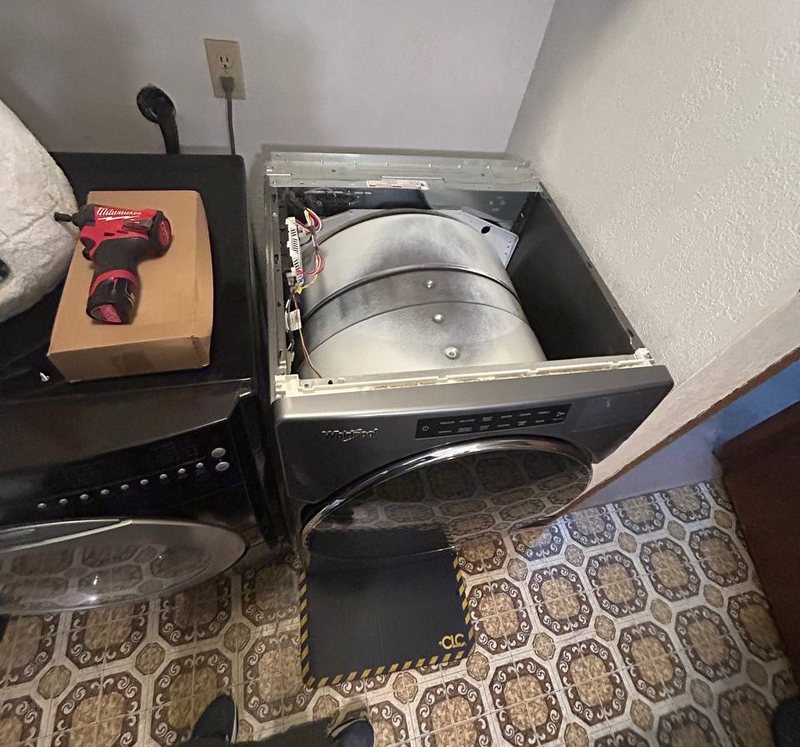
East of France Ave, in the 1950s ramblers around Oxboro and along Penn and Lyndale, the dryer sits in the basement and vents through a rim-joist hood that is often three feet off the ground and buried under a snowbank by February. West of France, in the split-levels of the Hyland Lake and Bush Lake neighborhoods, the laundry is on the lower level with a vent that climbs the wall and exits under a deck, where the flap ices shut. The apartment buildings along American Blvd and 98th St run long vertical vents shared by several units. Each geometry fails in its own way, and we drive I-494 east carrying instruments to measure what the vent is doing before blaming the dryer.
Here is the Bloomington winter pattern. Snow packs against the exterior hood, the flap freezes, airflow drops by half, and the dryer’s high-limit thermostat starts cycling the heat off early. Loads take two runs. A few weeks of this and the thermal fuse opens, and the dryer turns without heat. On a gas dryer the same restriction shows up as an igniter that glows, a flame that lights, and a burner that shuts down after a minute. In the apartments, one tenant’s lint plug can cost three neighbors their heat. Every one of these calls ends with a working dryer and a plain answer about the vent.
Electric: an open heating element, a thermal fuse, or a high-limit thermostat, and occasionally half of the 240-volt breaker. Gas: igniter, flame sensor or the valve coils. We check the outlet first, then meter the heat circuit part by part. The failed one is almost always on the truck.
Vent restriction most often, a weak element or a clogged blower housing less often, and now and then a moisture sensor coated in fabric softener. We measure static pressure at the exhaust, look at the hood outside, and test the sensor bars. Then we tell you which fix is the dryer’s and which is the duct’s.
Flat-spotted rollers, a dry idler pulley, worn glides or a fraying belt. We open the cabinet, spin the drum by hand, and find the source. Rollers, pulleys, glides and belts for Whirlpool, Maytag, GE, Samsung and LG dryers are stocked, so this is usually a same-visit repair.
Lint has built up on the element or the burner housing, or a small item slipped past the drum seal into the heater box. We remove the drum, clean the heater area and the blower, and check the vent for a lint dam. In a basement rambler with a lint bed near the burner, this cannot wait a week.
Door switch, start switch, thermal fuse or a broken belt tripping the belt switch. We meter from the plug inward until we find the open circuit. On apartment stacked units the door switch is the usual answer and takes a few minutes once the cabinet is open.
LG and Samsung dryers measure their own exhaust and stop when it is poor. We confirm the restriction rather than assume it, check the sensor is reporting truthfully, clear what we can at the dryer and the hood, and tell you if the run needs a full cleaning beyond that.
We start at the outlet with a meter, because a dead leg on a 240-volt circuit is the cheapest fix in the trade and looks exactly like a burnt element. Then the cabinet opens and the heat circuit is traced end to end: thermal fuse, cycling thermostat, high-limit, element or igniter and flame sensor. A manometer on the exhaust tells us how hard the dryer is working to push air, and a walk outside tells us why. In a Hyland Lake split-level the hood under the deck often has an inch of ice in the flap. You get a named part, a plain report on the vent, and one price on paper before we replace anything.
Gas dryers are common in the older east-side ramblers where the line was run in the 1960s; electric dominates the split-levels and nearly every apartment. We repair Whirlpool, Maytag, Kenmore, GE, Samsung, LG, Frigidaire, Electrolux and Speed Queen dryers, plus the compact and ventless units in the newer buildings near Normandale Lake. For property managers, the tenant opens the door and you approve by text with the invoice and written warranty emailed. Airport and Mall of America shift workers get first or last window of the day. Pricing: $99 for the diagnostic, folded into the written repair price when you approve it; if you decline, $99 is the whole charge. Nothing is priced before it is tested.
Often the vent, and we measure rather than guess. A restricted duct or an iced hood makes a healthy dryer look weak. We read exhaust pressure at the machine, inspect the outside termination, test the moisture sensor, and then tell you which side of the wall the problem is on.
Yes. Stacked units and coin dryers in the buildings along American Blvd, 98th St and Old Shakopee Rd are routine. Managers can have a tenant or caretaker meet us, approve the written number by text, and receive the paperwork by email. Shared vertical vents get a specific look because one plug affects several units.
It is a symptom of restricted airflow or a failing flame sensor, and the dryer is shutting itself down on purpose, which is the safety working. It should still be looked at soon. We test the sensor and the coils, measure the vent, and leak-check the connection before we leave.
We hold early and late windows six days a week for exactly that. Bloomington is a short run down I-494 from Eden Prairie, so an eight o’clock arrival or a late-afternoon slot is realistic. Say which shift you work when you book and we will fit it.
We do not price a dryer we have not tested. The $99 diagnostic comes first; then you get one written number for the full repair with the $99 already inside it. If you decide against the repair, the $99 is the entire bill.
What is happening, what is safe to check, when to call
Read the guide →What is happening, what is safe to check, when to call
Read the guide →Call (763) 342-9995 or send the form. You get a callback with a real arrival window, and a text when the truck is on its way.
The technician tests the machine, names the failed part in plain words, and writes one flat price. The $99 is already inside it.
We stock the parts that actually fail in west-metro homes, so most jobs close the same visit; an ordered part comes back with no second trip fee.
Full test cycle before we pack up, a clean work area after, and a written warranty on the invoice.
One call starts it: $99 finds the fault, one written number, repair from the truck, written warranty.